
Academic studies documenting thousands of scam tokens and millions in estimated investor losses are prompting renewed discussion over whether decentralized exchanges can strengthen user protection without compromising permissionless innovation.
LONDON, United Kingdom – August 6, 2026 – As millions of new tokens are launched across decentralized exchanges each year, researchers and blockchain developers are increasingly questioning whether permissionless trading and meaningful user protection must remain mutually exclusive.
Permissionless finance has become one of decentralized finance's (DeFi) defining principles, allowing anyone to create a token, add liquidity, and begin trading without centralized approval. The model has helped fuel innovation across the Ethereum ecosystem, enabling everything from governance tokens to the rapid growth of meme coins.
However, researchers say the same openness has also reduced barriers for malicious actors.
Academic studies published over the past several years suggest that fraudulent token launches remain widespread on decentralized exchanges, creating significant challenges for retail investors attempting to distinguish legitimate projects from malicious smart contracts.
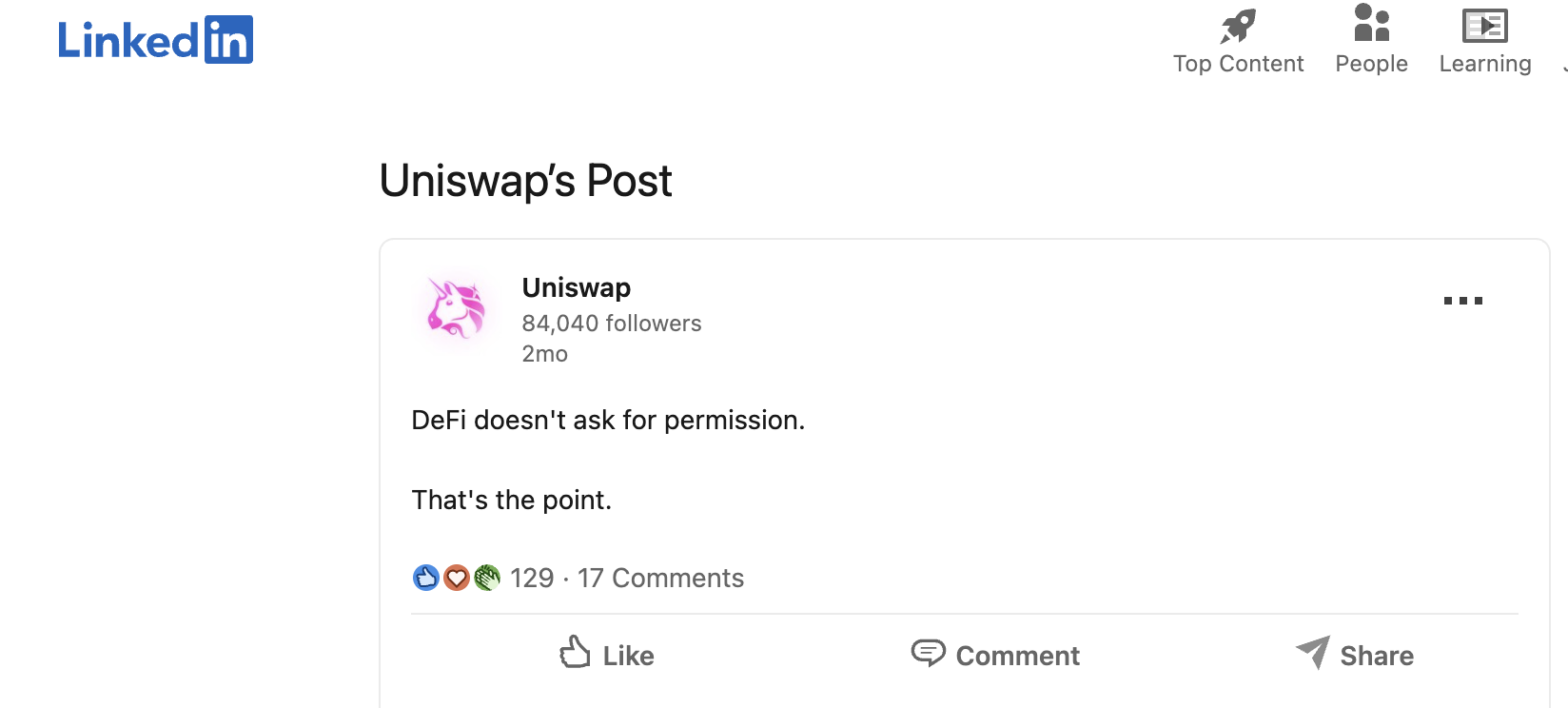
Uniswap, one of the largest decentralized exchanges, has publicly embraced permissionless innovation, stating on LinkedIn that "DeFi doesn't ask for permission. That's the point." While the philosophy reflects the protocol's commitment to decentralization, it has also become central to an ongoing discussion about how decentralized platforms should balance openness with user protection.
 Growing Evidence From Academic Research
Research examining token launches on decentralized exchanges has identified a persistent pattern of malicious deployments.
A 2022 study conducted by researchers from Universitat Pompeu Fabra and the University of Barcelona analyzed more than 27,000 tokens launched on Uniswap V2 and found that only a relatively small percentage appeared free from characteristics commonly associated with rug pulls or malicious contract behavior.
Additional research from the Department of Computing at The Hong Kong Polytechnic University identified more than 10,000 scam tokens on Uniswap, estimating losses of at least $16 million across nearly 40,000 identifiable victims.
More recently, research published in ScienceDirect in April 2026 reported that more than 98% of newly minted tokens on Uniswap V2 exhibited characteristics associated with fraudulent or malicious behavior.
Researchers note that commonly cited trust indicators, including locked liquidity, do not necessarily eliminate risks such as honeypots, hidden mint functions, blacklist mechanisms, or privileged administrative controls embedded within smart contracts.
Collectively, the studies suggest that identifying malicious contracts remains difficult for many retail participants despite the transparent nature of blockchain technology.
User Responsibility Versus Platform Responsibility
Supporters of decentralized exchanges argue that permissionless systems are intended to remove centralized gatekeepers and allow markets to determine value without approval processes.
Others contend that the absence of listing standards has shifted nearly all responsibility for contract analysis onto individual users, many of whom lack the technical expertise required to review Solidity smart contracts before executing transactions.
The debate increasingly centers on whether decentralized exchanges should provide additional transparency tools—such as contract risk indicators, transaction simulations, or security warnings—while preserving permissionless access.
Rather than introducing centralized approval systems, many researchers argue that better visibility into contract risks could improve user decision-making without altering the decentralized nature of the protocol.
Exploring Alternative Protocol Designs
Alongside improvements in transparency, several emerging decentralized exchanges are experimenting with different protocol mechanics designed to reduce incentives associated with certain types of malicious behavior.
One example is Motoswap, an Ethereum-based decentralized exchange that restructures trading incentives by automatically burning liquidity provider (LP) tokens at launch, distributing creator fees in the quote asset rather than the native token, and returning a portion of swap fees to traders.
According to the project, these mechanics are intended to reduce incentives for traditional liquidity-pull rug schemes while maintaining permissionless market access.
The project notes that burned liquidity alone does not prevent honeypots, hidden mint functions, or blacklist capabilities, and says additional standardized token-contract designs are being developed to address those risks separately.
An Industry-Wide Discussion
Researchers and developers increasingly agree that permissionless finance was never intended to eliminate investment risk. The discussion has instead shifted toward whether decentralized exchanges can evolve to provide better transparency and stronger economic incentives without compromising the principles that enabled decentralized finance to grow.
As academic research continues documenting the scale of malicious token deployments, the broader blockchain industry faces an increasingly important question:
Can decentralized exchanges preserve permissionless innovation while improving protections for the millions of users entering Web3 each year?
About Motoswap
Motoswap is a decentralized exchange built on Ethereum that focuses on aligning protocol incentives with long-term ecosystem sustainability. The platform automatically burns liquidity provider (LP) tokens at launch, distributes creator fees in the quote asset rather than the traded token, and shares a portion of swap fees with traders. Its protocol is designed to maintain permissionless market access while reducing economic incentives commonly associated with liquidity-pull rug schemes.
Links:
Uniswap LinkedIn Post:
Academic Research by Department of Information and Communications Technology, Pompeu, Barcelona, Spain & Faculty of Economics and Business, Universitat de Barcelona, Spain:
Do Not Rug on Me: Leveraging Machine Learning Techniques for Automated Scam Detection: https://www.mdpi.com/2227-7390/10/6/949
Academic Research by Department of Computing at The Hong Kong Polytechnic University:
Trade or Trick?: Detecting and Characterizing Scam Tokens on Uniswap Decentralized Exchange:
Academic Research on Science Direct:
Detecting rug pulls in decentralized exchanges: The rise of meme coins:
https://www.sciencedirect.com/science/article/pii/S2096720925000636