
Residue Control Redefines Surface Hygiene: Low-QAC Disinfection Booster Systems Shift from Add-On to Operational Essential
NEWARK, DE / ACCESS Newswire / May 5, 2026 / According to the latest market analysis by Future Market Insights, growth in the multi-surface disinfection booster systems with low QAC load market is being driven by the rising need to reduce chemical residue while maintaining effective surface disinfection across high-frequency cleaning environments. As healthcare facilities, commercial kitchens, and public spaces intensify hygiene protocols, the focus is shifting from simply achieving microbial kill to ensuring cleaner surface finish, lower streaking, and safer repeated use. What was once considered a formulation enhancement is now emerging as a core performance differentiator, particularly as regulatory bodies introduce clearer residue measurement frameworks and institutional buyers demand greater transparency in cleaning outcomes.
This transition reflects a deeper structural change in the cleaning chemicals ecosystem. Disinfection is no longer judged solely by efficacy claims, but by how consistently products perform across surfaces, shifts, and user conditions. Booster systems-especially those enabling lower quaternary ammonium compound (QAC) loads-are increasingly central to balancing efficacy with usability, residue control, and compliance. As a result, suppliers and facility managers alike are re-evaluating formulation strategies, dosing systems, and workflow integration to align with evolving hygiene expectations.
Get detailed market forecasts, competitive benchmarking, and pricing trends: https://www.futuremarketinsights.com/reports/sample/rep-gb-32986
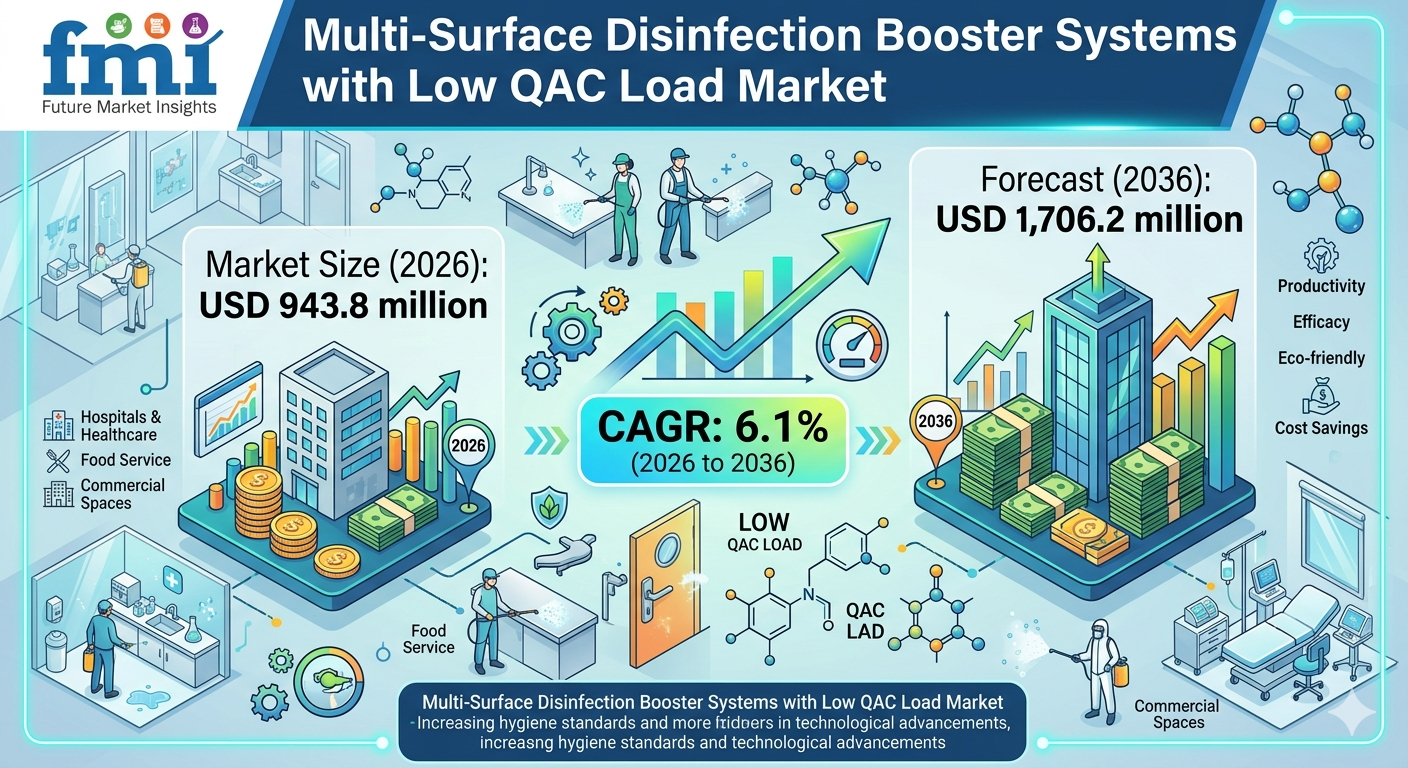
Quick Stats Snapshot (2026-2036)
Market size (2026): USD 943.8 million
Projected value (2036): USD 1,706.2 million
CAGR (2026-2036): 6.1%
2025 baseline: USD 889.5 million
Leading surface: Hard nonporous (49.5% share)
Top booster type: Surfactant synergists (34.0%)
Dominant compatibility: Low QAC systems (46.0%)
Leading formulation: Liquid concentrates (41.0%)
Primary end use: Healthcare facilities (38.0%)
Fastest-growing markets: India (8.0%), China (7.4%)
Market Size and Forecast
The market is projected to expand steadily from USD 943.8 million in 2026 to USD 1,706.2 million by 2036, reflecting a shift from optional formulation optimization to essential hygiene system design. This growth is closely tied to institutional cleaning demand, where routine, high-frequency disinfection requires products that perform consistently without leaving visible or chemical residue.
Unlike traditional disinfectant markets driven by volume consumption, this segment is shaped by performance expectations-particularly in environments where repeated wiping of surfaces like counters, medical equipment, and food preparation areas demands both efficacy and surface integrity. As a result, booster systems are increasingly embedded into procurement decisions rather than treated as secondary additives.
Growth Drivers: From Chemical Load to Cleaning Precision
Residue visibility and regulation: With regulatory bodies introducing standardized residue testing methods, particularly for QAC-based disinfectants, buyers now have measurable benchmarks to compare products. This is pushing formulators toward low-QAC systems supported by booster technologies.
High-frequency cleaning environments: Hospitals, transport hubs, and foodservice operations require repeated disinfection cycles. Boosters help maintain cleaning performance while minimizing streaking, film buildup, and rinse requirements.
Improved wetting and contact efficiency: Surfactant synergists enhance surface coverage, allowing lower active chemical loads without compromising disinfection claims-making them central to modern formulations.
Shift toward controlled dilution systems: Measured dosing formats such as liquid concentrates and cartridges are gaining traction as facilities seek to reduce human error and maintain consistent cleaning outcomes.
Market Challenges: Execution Over Innovation
Despite favorable growth, the market faces practical constraints:
Dilution accuracy risks: Incorrect mixing can reduce efficacy, undermining trust in low-QAC systems
Training and compliance gaps: Facility staff may lack standardized procedures for advanced dosing systems
Fragmented adoption: Smaller institutions may prioritize cost over performance optimization
Surface compatibility concerns: Expanding into electronics and sensitive surfaces requires careful formulation balance
These challenges highlight that adoption barriers are less about product capability and more about operational discipline and user education.
Opportunities: Where Competitive Advantage Is Forming
Residue-proof positioning: Suppliers offering validated residue data can command premium positioning
Electronics-safe disinfection: Growth in shared digital devices is opening new low-residue use cases
Dosing system integration: End-to-end solutions combining chemistry with dispensing systems will gain traction
Emerging market expansion: Rapid growth in India and China reflects increasing institutional hygiene standards
Segmentation Insights: Where Demand Is Concentrated
Booster Type: Surfactant synergists lead with 34.0% share due to their ability to improve wetting and reduce required active load.
Disinfectant Compatibility: Low QAC systems dominate at 46.0%, benefiting from familiarity and established usage in institutional cleaning.
Formulation Mode: Liquid concentrates hold 41.0% share, driven by refill programs and controlled dilution systems.
Surface Coverage: Hard nonporous surfaces lead with 49.5%, reflecting frequent cleaning of counters, floors, and equipment.
End Use: Healthcare facilities account for 38.0%, where hygiene standards and repeated cleaning cycles are most stringent.
Sales Channel: Direct institutional supply leads with 43.0%, as large facilities require product support and dosing guidance.
Customize insights for your business strategy: https://www.futuremarketinsights.com/customization-available/rep-gb-32986
Regional Analysis: India and China Drive Momentum
India (8.0% CAGR): Growth is fueled by private healthcare expansion and organized foodservice sectors adopting stricter cleaning protocols and lower-residue products.
China (7.4% CAGR): Demand is driven by transport infrastructure, factory canteens, and large-scale facility cleaning programs.
United States (6.5% CAGR): Market maturity is supported by regulatory clarity and healthcare compliance requirements.
Europe: Countries such as the United Kingdom and Germany show steady growth, driven by safety standards and product validation requirements.
Japan and South Korea: Mature markets focusing on incremental improvements in surface safety and cleaning consistency.
Competitive Landscape: Performance Beyond Chemistry
Key players include Ecolab, Diversey, The Clorox Company, Reckitt, BASF, Stepan Company, and Nouryon.
Competition is increasingly defined by:
Proven residue control performance
Integration with dosing and dispensing systems
Surface compatibility across diverse environments
Post-sale support and training for institutional users
Companies that combine formulation expertise with real-world application support are better positioned to secure long-term contracts.
Strategic Implications for Decision-Makers
Facility managers: Prioritize systems that reduce residue while maintaining cleaning efficiency across high-touch surfaces
Procurement teams: Evaluate total system performance, including dosing accuracy and supplier support
Manufacturers: Invest in formulation technologies that balance efficacy with user-friendly application
Investors: Focus on companies enabling measurable performance improvements in institutional hygiene
Future Outlook: From Additive to Standard Practice
Over the next decade, low-QAC booster systems are expected to transition from niche formulation tools to standard components of institutional cleaning programs. As residue measurement becomes more transparent and hygiene expectations continue to rise, the ability to deliver consistent, low-residue disinfection will define market leaders.
The projected 6.1% CAGR reflects steady, necessity-driven adoption-anchored not in episodic demand, but in the ongoing evolution of hygiene standards across healthcare, foodservice, and public infrastructure.
Unlock 360° insights for strategic decision making and investment planning: https://www.futuremarketinsights.com/checkout/32986
Executive Takeaways
Residue control is becoming as important as disinfection efficacy
Market growth is driven by operational needs, not just chemical innovation
Booster systems are central to achieving low-QAC performance targets
India and China offer the strongest growth opportunities
Suppliers that integrate chemistry with dosing and support systems will lead
In a market where surface cleanliness is judged both visually and scientifically, low-residue disinfection is no longer optional. For organizations managing high-frequency cleaning environments, booster systems are quickly becoming essential to delivering consistent, compliant, and user-safe hygiene outcomes.
Explore More Related Studies Published by FMI Research:
Babesiosis Treatment Market: https://www.futuremarketinsights.com/reports/babesiosis-treatment-market
Eisenmenger Complex Management Market: https://www.futuremarketinsights.com/reports/eisenmenger-complex-management-market
Central Pain Syndrome Management Market: https://www.futuremarketinsights.com/reports/central-pain-syndrome-management-market
PD1 Non-Small Cell Lung Cancer Treatment Market: https://www.futuremarketinsights.com/reports/pd1-non-small-cell-lung-cancer-treatment-market
Klinefelter Syndrome Therapeutics Market: https://www.futuremarketinsights.com/reports/klinefelter-syndrome-therapeutics-market
About Future Market Insights (FMI)
Future Market Insights (FMI) is a leading provider of market intelligence and consulting services, serving clients in over 150 countries. Headquartered in Delaware, USA, with a global delivery center in India and offices in the UK and UAE, FMI delivers actionable insights to businesses across industries including automotive, technology, consumer products, manufacturing, energy, and chemicals.
An ESOMAR-certified research organization, FMI provides custom and syndicated market reports and consulting services, supporting both Fortune 1,000 companies and SMEs. Its team of 300+ experienced analysts ensures credible, data-driven insights to help clients navigate global markets and identify growth opportunities.
For Press & Corporate Inquiries
Rahul Singh
AVP - Marketing and Growth Strategy
Future Market Insights, Inc.
+91 8600020075
For Sales - sales@futuremarketinsights.com
For Media - Rahul.singh@futuremarketinsights.com
For web - https://www.futuremarketinsights.com/
For Web: https://www.factmr.com/
SOURCE: Future Market Insights, Inc.
View the original press release on ACCESS Newswire